

Besides buying a house, a new car is probably the biggest investment you’re likely to make in your life. And just as you would take care to insure your house for its full value to protect your finances and your family, it’s important that you insure your car for all that it’s worth, so that you know that in the event that the worst happens, you can get a similar replacement at no extra cost and with little hassle. Unfortunately, that’s not always the case, and you should always ‘mind the gap’.
What is Gap Insurance?
If you write your car off in an accident, or it is stolen or otherwise lost or destroyed, your insurer will of course pay out, provided that you have the correct policy. But the amount that they pay out will not always reflect the amount that you originally paid for the car, even if it was relatively recently.
When you buy a new car and insure it, you will usually be able to get it replaced on a like for like basis within the first year of your ownership. But outside of this, or another stated period, you are unlikely to receive the full value of the vehicle, and this may lead to difficulties getting a suitable and satisfactory replacement.
When paying out on a claim, car insurers tend to pay out the market value of the car. Because of the way that vehicles depreciate over time and due to fluctuations in demand and supply of certain models and makes of car, this will often not be the same as what you originally paid for it, and will in all probability be considerably lower.
In the event of this being the case, you may find that you do not have enough money to purchase an identical or even similar standard of vehicle, without paying out as much as several thousands of pounds extra on top of your car insurance payout. Gap insurance will effectively prevent this situation from taking place.
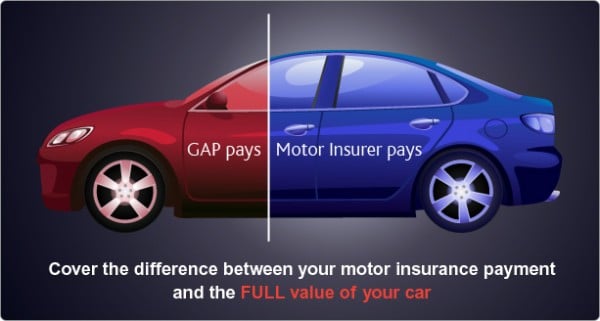
Gap insurance will make up the difference between what you originally paid for the vehicle, and the amount that your regular insurance is set to pay out for a claim. It is effectively a way of safeguarding your investment in the vehicle, preserving the value of that investment, and making sure that you are able to replace the vehicle with another one like it.
Why you Shouldn’t take on a Finance Deal Without Gap Insurance
If you’re buying a vehicle on finance then gap insurance can also be invaluable, and is highly advisable.
Without gap insurance, buying a car on a finance deal can be a risky endeavour. Imagine a scenario in which you buy a car on a finance deal for £12,000. Four years later you’ve paid off £5,000 of that, leaving an outstanding balance of £7,000. Your vehicle is involved in an accident, and is a complete write-off. The value of your vehicle has depreciated quite rapidly over the past year or two, and so the amount you are paid out for it is only £5,500 – £1,500 short of what you still owe to the finance company. In this scenario, you would have to continue paying out for a car you don’t own, or stump up the rather hefty difference from your own pocket.
But if you had gap insurance tailored towards your finance deal, this would cover the ‘gap’ between what your insurance pays out and what you still owe to the finance company.
When buying gap insurance, be sure to check the terms and conditions and check what is covered by the deal. You should also be mindful of clauses such as ‘limited claim periods’, which stipulate that you must claim within a short amount of time for your gap cover to be valid.